
Why Would an Expert Pay to Be on TV? The Difference Between Buying Access and Buying Credibility
By Dr. Trudy Beerman
CEO & TV Host, PSI TV Network | Creator of REACHology®
Published August 24, 2026
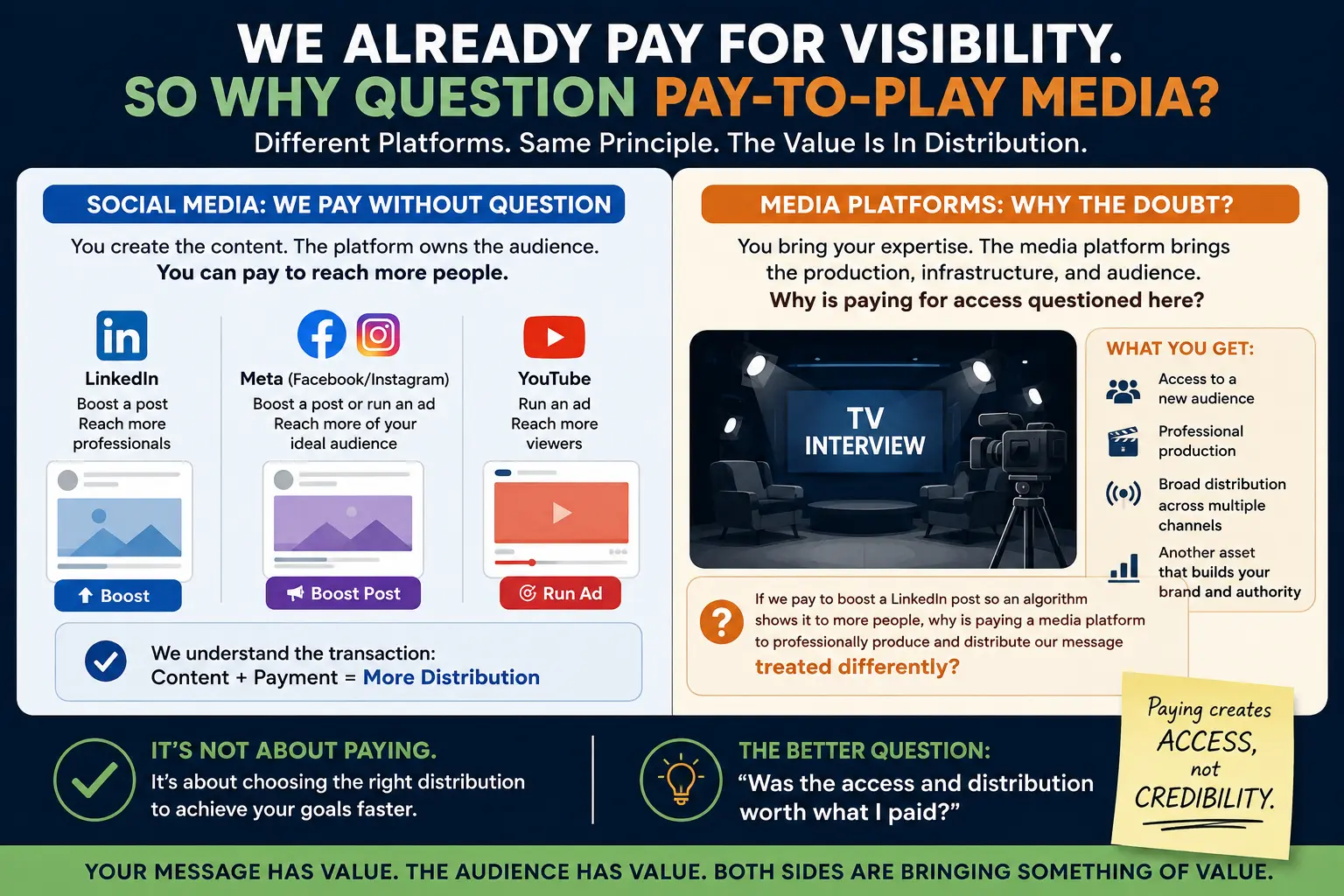
If you are already an accomplished expert, author, speaker, consultant, coach, founder, or thought leader, you may reasonably ask a question when you encounter a paid television opportunity: Why should I pay to appear when some people get invited onto television for free?
It is a fair question. An earned media invitation carries value precisely because someone else selected you. But earned media and paid media solve different problems, and choosing to invest in media access does not mean you were incapable of earning an invitation. Sometimes it simply means you have decided not to leave the timing of your visibility entirely in someone else's hands.
There Is More Than One Way Onto a Platform
Media opportunities generally come through different paths. You may be invited because a producer discovered your work. You may pitch yourself or have a publicist pitch you. You may own the platform yourself. You may also choose to pay for access to a platform that offers a commercial participation model.
None of those paths, by itself, tells us whether the person appearing has meaningful expertise. The real question is what the person brings to the platform and what the platform provides in return.
This is why PSI TV makes an important distinction: paying for access is not the same thing as paying for credibility.
You Bring the Expertise. We Provide the Infrastructure.
A PSI TV appearance cannot give you twenty years of experience you do not have. It cannot write the book you never wrote, produce the client results you never achieved, create credentials you did not earn, or manufacture a body of knowledge that does not exist.
What a media platform can do is give existing expertise somewhere else to travel.
That is what experts are investing in when they choose a paid PSI TV opportunity. They are accessing media infrastructure: an interview environment, professional content production, television and digital distribution, and exposure to audiences beyond the ones they have already built for themselves.
You bring the authority. The platform helps distribute the evidence of it.
Why Not Just Wait for an Invitation?
You certainly can. Earned media should remain part of a strong authority strategy, and being independently selected by a respected platform creates a valuable third-party signal. We encourage experts to pursue those opportunities.
The problem is making waiting the strategy.
You do not control when a producer discovers you, when a journalist needs precisely your expertise, when a conference organizer decides you fit an upcoming program, or when someone with access happens to mention your name in the right room. You can improve your probability of being discovered, but you cannot dictate the timing.
A legitimate paid media option changes that equation. Instead of asking only, "When will somebody choose me?" you can evaluate the opportunity and decide, "Do I choose this platform?"
Sometimes the Investment Is Really About Time
Suppose two businesses eventually generate the same amount of revenue, but one takes decades to reach the number while the other reaches it much sooner. The final number may be identical, but the timelines are not economically equivalent. Speed creates additional time in which the result can produce other results.
Visibility can compound in a similar way. One media appearance can become content for your website, something prospects discover while researching you, material to share through social channels, another searchable reference associated with your expertise, or evidence that helps someone considering you for another opportunity.
No legitimate platform can guarantee what any particular appearance will produce. But when an expert has a reason to become more visible now rather than someday, paying for appropriate distribution can be a rational decision.
Businesses Pay for Distribution Every Day
Companies routinely pay to reach audiences. They buy advertising, sponsor conferences, exhibit at trade shows, produce videos, hire publicists, purchase digital media, and invest in content distribution. The existence of a financial transaction does not automatically make the resulting visibility meaningless.
Marketing has long distinguished among paid, owned, and earned media, and those channels can work together rather than requiring a brand to choose only one. Nielsen has specifically discussed the value of combining paid, owned, and earned media as parts of a broader strategy.
Source: Nielsen, “Trust in Advertising: Paid, Owned and Earned”
An established expert can therefore own a website and YouTube channel, earn podcast and media invitations, and purchase selected distribution opportunities at the same time. Each does a different job within the larger authority ecosystem.
Transparency Matters
Where paid media becomes problematic is when payment is used to create a false impression of independent editorial endorsement. PSI TV does not believe experts need that kind of ambiguity to benefit from media exposure.
The Federal Trade Commission has repeatedly emphasized that consumers should not be misled about the commercial nature of content and that disclosures should be clear and prominent when necessary. Transparency allows audiences to understand what they are seeing while evaluating the substance of the message for themselves.
Source: Federal Trade Commission, “Native Advertising: A Guide for Businesses”
For us, that principle reinforces an important distinction. A commercial relationship can purchase an opportunity to appear. It should not purchase a fabricated claim that the person was independently selected, endorsed, or declared authoritative by the platform when that is not what happened.
Then What Is the Authority Signal?
The authority signal is not simply, "I was on TV." The stronger signal is what someone discovers when they watch you there.
Can you explain your area of expertise clearly? Do you have an informed point of view? Can you answer substantive questions? Do your ideas demonstrate experience and depth? Does what you say on camera align with the credentials, publications, results, and body of work someone discovers elsewhere?
That is why visibility works best when it amplifies something real. Media exposure gives people another opportunity to encounter and evaluate your expertise. It does not eliminate their ability to decide whether you actually know what you are talking about.
We Believe Experts Should Have More Agency Over Their Visibility
PSI TV actually began as a platform for our founder's own message and expertise. Over time, the platform expanded to make its infrastructure and distribution available to other people with voices worth sharing.
That evolution reflects something we continue to believe: accomplished people should not always have to wait for a gatekeeper to discover them before they can access meaningful distribution. There should also be legitimate ways for experts to evaluate an opportunity, decide it serves their objectives, invest in it, and bring their expertise to a new audience.
That does not eliminate gatekeeping entirely. A responsible platform still has to care about what it distributes, the experience it creates for its audience, and the people with whom it associates its name. Paid access should never mean that standards disappear.
A Rising Tide Can Lift More Than One Boat
There is another reason PSI TV opened its platform to other voices. We believe media can create value in more than one direction. When an expert brings a valuable message to PSI TV, our audience gains access to that expertise. The expert gains access to additional distribution. PSI TV becomes stronger because worthwhile voices make the platform itself more useful.
That is the kind of growth we want.
Philippians 2:4 offers a principle that fits our philosophy well: “Let each of you look not only to his own interests, but also to the interests of others.” Building a successful platform and contributing to someone else's rise do not have to be competing objectives.
We want PSI TV to grow. We also want the experts who choose to bring their voices to this platform to benefit from the infrastructure we are building. A rising tide can lift all boats.
So, Should You Pay to Be on TV?
Not necessarily.
Every paid media opportunity should earn your investment. Ask who the audience is, where the content will be distributed, what is included, what assets you receive, how long those assets remain useful, whether the platform is credible, and whether the opportunity supports an actual visibility or authority objective.
If the only thing you are buying is the ability to say, "I was on TV," that may not be enough.
But if you already have meaningful expertise and the investment gives that expertise access to useful production, broader distribution, a new audience, and another durable piece of content that supports your authority ecosystem, the question becomes different.
You are no longer asking whether you were important enough to be chosen.
You are deciding whether the platform is valuable enough for you to choose it.
```About the Author
Dr. Trudy Beerman
CEO & TV Host, PSI TV Network · Creator of REACHology® & Authority Architecture™
DSL, Liberty University · 2024 Top Leadership Mentor in Media & Brand Influence
Dr. Beerman, the REACHologist®, architects the transition from private brilliance to public authority for established experts. She operates a media visibility and brand-elevation platform for mature/seasoned experts and CEOs ready to expand their influential reach. Through PSI TV, she delivers branded TV exposure, strategic content placement, and multi-channel distribution across Apple TV, Roku TV, and Amazon Fire TV.
Explore the REACHology® Framework
Browse the REACHology® Glossary → · 95+ terms defined by Dr. Trudy Beerman