
Why Founder Visibility Can Strengthen — or Destabilize — Your Business
By Dr. Trudy Beerman
CEO & TV Host, PSI TV Network | Creator of REACHology®
Published April 17, 2026
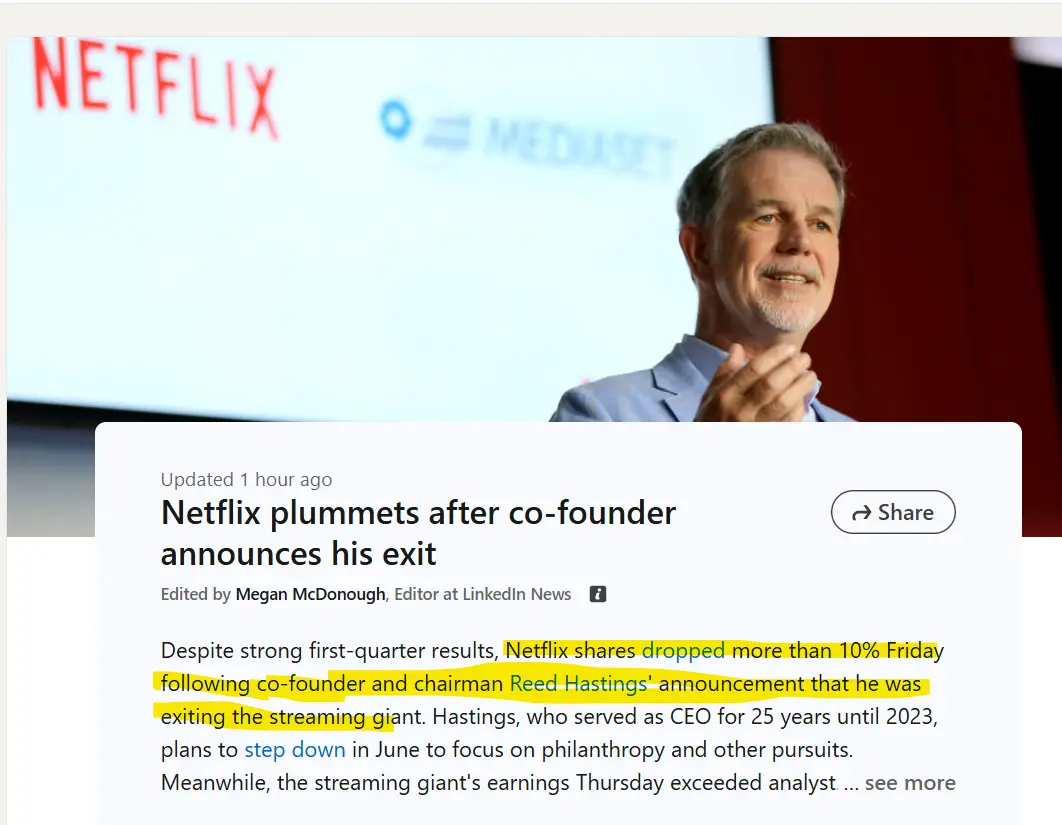
I saw a headline on LinkedIn that caught my attention.
A company’s valuation shifted after a founder exit announcement.
Not because of a product failure. Not because of poor performance.
Because the founder was the signal.
According to a LinkedIn News report, Netflix shares dropped following the announcement that co-founder Reed Hastings would step away, despite strong financial performance. :contentReference[oaicite:0]{index=0}
That moment is worth studying.
Because for founder CEOs building visibility, influence, and brand authority… this is not just a news story.
This is a blueprint — and a warning.
What Are Authority Signals — and Why They Matter for Founders
Authority signals are the digital and perceptual indicators that communicate credibility, trust, and leadership.
They include:
- Media presence
- Platform visibility
- Thought leadership
- Brand associations
- Audience engagement
For founder CEOs, these signals often originate from the individual first.
And that’s not a mistake.
In the early stages, the founder is the fastest path to trust.
Your voice. Your story. Your presence.
They create momentum.
The Hidden Risk: When the Founder Becomes the Business
Here’s where it becomes strategic.
If your authority signals are too concentrated in you, your business doesn’t just benefit from your presence…
It becomes authority dependency.
That creates what I call a single-point-of-failure signal structure.
And the market recognizes it immediately.
In Netflix’s case, even with strong earnings, the combination of a founder exit and forward uncertainty contributed to a notable drop in investor confidence. :contentReference[oaicite:1]{index=1}
The authority was not fully distributed. It was still perceived as centralized.
The Three Phases of Founder Authority Signals
In my work with REACHology® and Authority Architecture™, founder-led brands move through three distinct phases.
1. Signal Borrowing (Early Stage)
The company borrows authority from the founder (signal borrowing).
This accelerates trust and visibility.
2. Signal Sharing (Growth Stage)
The company begins to generate its own authority signals (signal sharing).
Other voices, platforms, and assets contribute to credibility.
3. Signal Independence (Maturity Stage)
The company stands as an authority without requiring the founder’s constant presence (signal independence).
The founder enhances the brand — but no longer defines its stability.
Most businesses never fully transition out of phase two.
Why Gentle Detachment Is a Strategic Advantage
The goal is not to remove the founder.
The goal is to rebalance the authority signals over time.
I call this gentle detachment.
It looks like:
- Introducing additional credible voices
- Building platform-level authority
- Creating repeatable formats that stand on their own
- Shifting language from “I” to “we”
This is not a retreat.
It is an evolution.
Authority Architecture™: Building a Business That Outlasts You
Inside Authority Architecture™, this is intentional design.
You are not just building visibility.
You are building:
- Transferable trust
- Scalable authority systems
- Signal distribution across people, platforms, and content
When done well, the narrative shifts from:
“This business works because of the founder”
To:
“This business works because of the system the founder built”
What This Means for Founder CEOs Today
If you are actively building your personal brand, you are doing the right thing.
But you must also ask:
Am I building authority that depends on me… or authority that exists because of me?
That distinction determines whether your brand is:
- Scalable
- Sellable
- Sustainable
People Also Ask
What are authority signals in business?
Authority signals are indicators that establish credibility and trust, such as media presence, thought leadership, and platform visibility.
Why can a founder’s exit impact a company’s value?
If authority signals are heavily tied to the founder, their exit creates uncertainty about the company’s future performance and leadership.
How can founders reduce dependency on their personal brand?
By building distributed authority through teams, platforms, repeatable formats, and system-driven credibility rather than individual presence alone.
What is Authority Architecture™?
Authority Architecture™ is the strategic design of authority signals to create scalable visibility, credibility, and influence beyond a single individual.
Your Next Step
If your brand is generating attention, you are building visibility.
If your authority signals are transferable, you are building enterprise value.
Those are not the same.
Start building accordingly.
About the Author

Dr. Trudy Beerman
CEO & TV Host, PSI TV Network · Creator of REACHology® & Authority Architecture™
DSL, Liberty University · 2024 Top Leadership Mentor in Media & Brand Influence
Dr. Beerman, the REACHologist®, architects the transition from private brilliance to public authority for established experts. She operates a media visibility and brand-elevation platform for mature/seasoned experts and CEOs ready to expand their influential reach. Through PSI TV, she delivers branded TV exposure, strategic content placement, and multi-channel distribution across Apple TV, Roku TV, and Amazon Fire TV.
Explore the REACHology® Framework
Browse the REACHology® Glossary → · 95+ terms defined by Dr. Trudy Beerman