
Visibility Strategy: Why Perceived Value Matters More Than Viral Numbers
By Dr. Trudy Beerman
CEO & TV Host, PSI TV Network | Creator of REACHology®
Published May 14, 2026
There was a time when sheer visibility alone carried enormous weight. A viral video. A massive following. Millions of views. For years, the internet trained people to believe that popularity and credibility were nearly interchangeable. If enough people watched, shared, or reacted, then the creator must be important.
But the digital landscape is changing. Today, algorithms, audiences, and even search engines are becoming more sophisticated about trust, authority, and relevance. Visibility still matters, but the type of visibility matters more than ever.
This is especially important for experts, founders, consultants, authors, and professionals building long-term authority rather than temporary attention. At PSI TV, we believe the future belongs not simply to those with the loudest reach, but to those with the strongest perceived value inside the right ecosystems.
The Value of a PSI TV Appearance
Most experts think visibility works like a light switch.
You post once. Appear once. Go viral once. And suddenly the world notices.
But influence rarely works that way. A TV appearance is often more like the smell of fresh bread or cinnamon drifting from a new bakery into the street. People walking by may not stop immediately, but they notice.
They register: "Something is there." "That smells interesting." "I should come back."
That is how authority often works.
Not through one loud moment, but through repeated signals that create familiarity, curiosity, trust, and perceived value over time.
At PSI TV, we understand that many experts already possess depth over noise.
They have: Experience over trends. Consistency over theatrics. Accumulated credibility over temporary spikes.
The challenge is not usually the absence of expertise.
It is the absence of visible authority signals that allows the market to recognize that expertise.
That is why strategic media matters.
- Every interview.
- Every feature.
- Every appearance.
- Every searchable conversation.
These become the "taste and see" moments of your authority ecosystem and even the best bakery still lets the aroma reach the street. The most accomplished expert still needs discoverable visibility pathways that keep the pipeline full.
Visibility is not begging for attention; it is deliciously inviting it.
The Traditional Media Tier System
In media and podcasting circles, there is already an understood hierarchy. Most industry professionals informally think about media opportunities in tiers, though the lines between those tiers are often shaped more by perception and relevance than by rigid audience numbers alone.
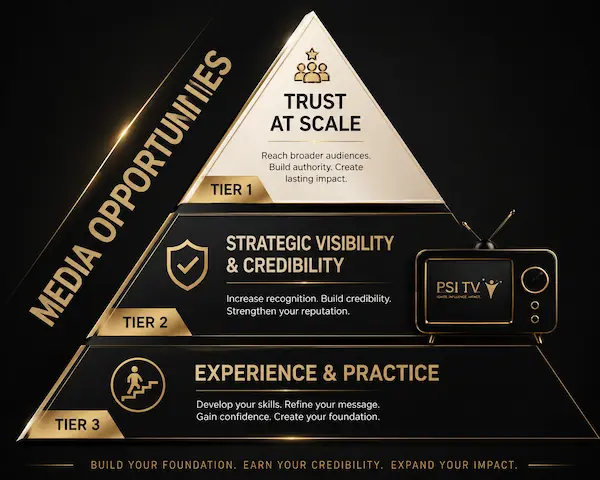
Tier 3: Emerging and Niche Platforms
These are smaller podcasts, local media outlets, niche YouTube channels, specialized publications, and emerging interview platforms. The audiences may be modest in size, but these platforms often provide targeted relevance, searchable authority signals, relationship opportunities, and valuable content repurposing assets.
For many experts, these appearances become the foundation of a media portfolio. They create public evidence that an expert is capable of carrying meaningful conversations, contributing insight, and participating within their industry ecosystem.
Tier 2: Established Industry Platforms
These are recognized industry podcasts, respected business publications, established creators, and mid-sized media ecosystems with strong audience trust. These platforms often carry stronger brand association, greater perceived authority, and higher-quality audience engagement.
This is often where experts begin transitioning from simply being visible to becoming recognized. The credibility transfer from respected hosts, platforms, and media ecosystems starts to compound more aggressively at this stage.
Tier 1: Elite Mass Visibility Platforms
These are globally recognized podcasts, national television appearances, elite publications, and major media brands. These platforms provide massive visibility, broad recognition, and large-scale trust transfer.
However, many professionals misunderstand how people typically reach this level. Major platforms rarely discover experts first. More often, they validate experts who have already accumulated visible authority signals elsewhere.
Visibility Is a Stacked Trust System
Every interview, article, podcast appearance, feature, or media contribution becomes public evidence. Evidence that someone trusted you enough to feature you, that your ideas can sustain public conversation, and that your expertise resonates with audiences.
This is why media appearances matter even when the audience size is relatively small. The appearance itself becomes an authority signal that contributes to long-term discoverability, credibility, and recognition.
Why Relevance Often Outweighs Raw Numbers
This is where the conversation becomes more nuanced. Not all audiences carry equal value, and sophisticated visibility strategy requires understanding the difference between audience size and audience value.
A podcast with 5,000 highly targeted decision-makers may create more business impact than a general entertainment platform with 500,000 disengaged listeners. A niche medical podcast may carry enormous authority inside healthcare. A respected legal interview may shape perception within the legal industry despite modest download numbers.
In many cases, the true value of a platform is not measured by reach alone, but by audience quality, buying power, prestige perception, trust density, search visibility, relationship proximity, and ecosystem relevance. Sometimes the greatest value of a media appearance is not the audience itself, but the implied endorsement associated with the platform.
Virality Is Losing Its Monopoly on Credibility
Virality still creates attention, but attention and trust are no longer viewed as identical. Search engines, AI systems, recommendation engines, and audiences are increasingly evaluating signals tied to expertise, consistency, authority, reputation, and source quality.
In other words, the digital environment is shifting toward E-E-A-T: Experience, Expertise, Authority, and Trust. This evolution matters because virality alone can no longer guarantee perceived value or lasting credibility.
In some cases, highly viral content may even weaken perceived expertise if it appears disconnected from meaningful authority ecosystems. The future will likely place even greater emphasis on verified expertise, trusted associations, credible media ecosystems, subject-matter depth, and structured authority signals.
The Rise of Strategic Visibility
The experts who thrive in the next era will not necessarily be the loudest. They will be the most strategically positioned. They will understand that visibility compounds, credibility accumulates, and authority signals stack over time.
Most importantly, they will stop treating media as isolated vanity moments and start treating it as an authority ecosystem. Every interview, article, and platform appearance contributes to a larger pattern of recognized mastery.
Because in today's digital environment, visibility is no longer just about being seen. It is about being perceived as valuable by the audiences, platforms, algorithms, and ecosystems that matter most.
Dr. Trudy's Takeaways
- Visibility without relevance is increasingly fragile.
- Authority signals now matter more than isolated viral moments.
- Media opportunities should be evaluated by audience quality, trust density, and ecosystem relevance, not just audience size.
- Strategic visibility compounds over time and creates recognized mastery.
- The future of discoverability will increasingly reward credible authority ecosystems over raw attention metrics.
Frequently Asked Questions
What is a media portfolio?
A media portfolio is a collection of public appearances, interviews, articles, podcasts, television segments, and media contributions that demonstrate visible authority and expertise over time.
Why do smaller podcasts still matter?
Smaller podcasts often provide highly targeted audiences, niche relevance, and valuable authority signals that contribute to long-term discoverability and credibility.
What is an authority signal?
An authority signal is publicly observable evidence that reinforces expertise, credibility, trust, or recognition within a specific field or ecosystem.
Is virality still important?
Virality can still generate attention, but attention alone is becoming less reliable as a measure of expertise or trustworthiness.
What makes a media platform valuable?
Platform value increasingly depends on audience relevance, trust density, perceived prestige, ecosystem influence, and alignment with the expert's goals and industry.
End-of-Article Checklist
- Citations: N
- Data: N
- Bible verse: N
- Testimonial or review: N
- Case study or lived experience: Y
About the Author

Dr. Trudy Beerman
CEO & TV Host, PSI TV Network · Creator of REACHology® & Authority Architecture™
DSL, Liberty University · 2024 Top Leadership Mentor in Media & Brand Influence
Dr. Beerman, the REACHologist®, architects the transition from private brilliance to public authority for established experts. She operates a media visibility and brand-elevation platform for mature/seasoned experts and CEOs ready to expand their influential reach. Through PSI TV, she delivers branded TV exposure, strategic content placement, and multi-channel distribution across Apple TV, Roku TV, and Amazon Fire TV.
Explore the REACHology® Framework
Browse the REACHology® Glossary → · 95+ terms defined by Dr. Trudy Beerman