
TV Never Died. It Evolved. Why Your Brand Should Be Thinking About the Big Screen.
By Dr. Trudy Beerman
CEO & TV Host, PSI TV Network | Creator of REACHology®
Published August 08, 2026
Digital platforms captured the small screen. Now some of the world's biggest digital brands are investing in the biggest screen in the house. For experts, founders and thought leaders, that deserves attention.
For years, we were told television was dying. I never believed that. Television was changing.
The telephone did not die when it became a smartphone. The computer did not die when the desktop gave way to laptops, tablets and cloud computing. Television followed a similar technological evolution.
Broadcast television was joined by cable. Cable was disrupted by streaming. Channels became apps. Scheduled programming was joined by on-demand viewing.
The pipes changed. The big screen remained. And now something particularly interesting is happening.
Some of the digital platforms that became enormously successful capturing our attention away from traditional television are deliberately moving into the living room.
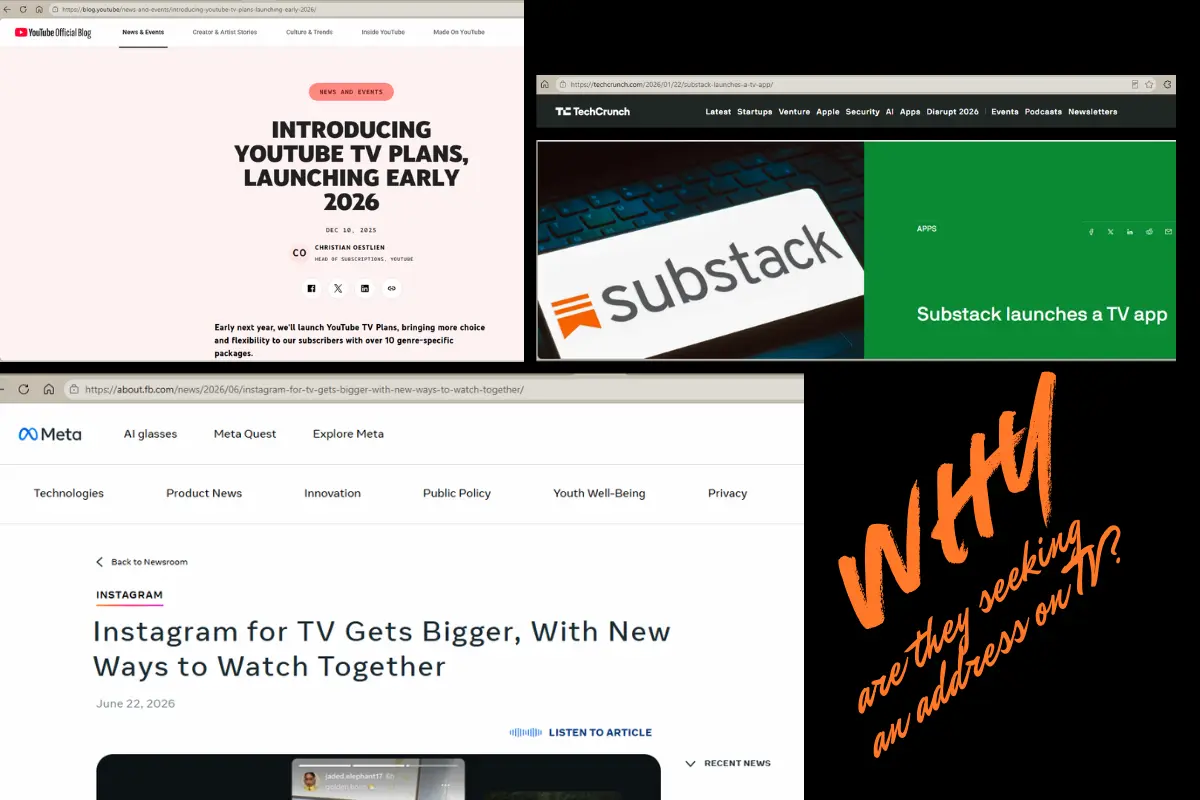
YouTube is leaning further into creator-led shows and connected-TV experiences. Instagram is expanding its television presence and exploring longer-form creator content, episodic series and live programming. Substack launched a television app for its creator video and livestream content.
These companies already had attention. So why do they want television?
Follow the Attention
The first clue is in the viewing data.
According to Nielsen's April 2026 Gauge report, streaming represented 47.6% of total television viewing. YouTube alone accounted for 13.4% of total television watch time. [Source: Nielsen]
Think about what that means. YouTube is not merely a website people visit on their computers, or an app people scroll on their phones. It has become a major part of television viewing.
That distinction matters because television creates a different viewing environment from the tiny personal screen we carry everywhere.
The Big Screen Can Turn Content Into an Event
Think Sunday Night Football.
Think election night.
Think the Olympics.
Think FIFA.
Think Sunday sermons.
Think family movie night.
The television has historically done something extremely well: it gives people a screen to gather around.
A phone is primarily a personal screen. A television can become a communal one, and one you can watch from your bed or couch. That matters as well because a relaxed state is less likely to swipe right than a mind looking for active stimulation.
When my family decides we are watching a movie together, changing what we are watching becomes a group decision. The content has become part of an experience.
Meta is paying attention to that behavior.
When the company announced the expansion of Instagram for TV in June 2026, it described friends and families watching together and announced additional features intended to make shared viewing easier. Meta also said it was exploring longer-form creator content, episodic series and live programming for television. [Source: Meta]
That is not simply Instagram creating a bigger version of a Reel. It represents a different viewing context.
From Random Videos to Shows
There is another shift happening at the same time.
Digital content is increasingly borrowing the architecture television has used for decades:
Shows. Episodes. Recurring formats. Familiar personalities. Continuing themes. Reasons to return.
At its 2026 Brandcast, YouTube highlighted an expanded slate of creator-led programming, including competition formats, talk programming and docuseries. [Source: YouTube]
This has enormous implications for experts who have spent years asking:
"What should I post this week?"
Perhaps the better question is: "What is my next episode?" Those questions produce very different content strategies.
One asks us to continuously invent something that might attract attention. The other asks us to build a recognizable body of work people have a reason to return to.
One Video Was Never a Relationship
This is particularly important for experts, coaches, consultants, authors and founders. We have spent years optimizing individual pieces of content for conversion.
Watch this video.
Click this link.
Download this resource.
Book this call.
But one encounter was never a relationship.
One television interview can create an authority signal. One podcast can introduce you to a new audience. One video can cause someone to notice you.
But familiarity requires repeated encounters. Television has understood this for generations. The objective of an episode was not merely to make people enjoy what they were watching tonight, it was to give them a reason to return next week.
That is why I believe experts should begin thinking beyond isolated content and toward shows, series, and connected bodies of work.
Your Expertise Can Become Programming
This does not mean every business owner needs to become a Hollywood producer.
A show can simply be a recognizable, repeatable experience built around an intellectual territory.
If you are a leadership expert, your videos do not have to be 20 unrelated leadership topics. You could create a limited series exploring one significant leadership question from several perspectives.
If you are an author, the chapters or central ideas in your book can become the architecture for a series.
If you are a consultant, recurring client problems can become episodes.
And several respected authorities can be curated around one overarching idea in much the same way contributors are assembled for a published anthology.
Think of a Television Series as a Video Anthology
| Publishing Model | Television Model |
|---|---|
| Anthology | Limited TV Series |
| Book Title | Series Title |
| Central Theme | Series Premise |
| Editor / Curator | Showrunner / Knowledge Broker |
| Anchor Author | Anchor Authority |
| Contributing Author | Contributing Expert |
| Chapter | Episode |
| Book Launch | Series Premiere |
| Published Book | Published Television Series |
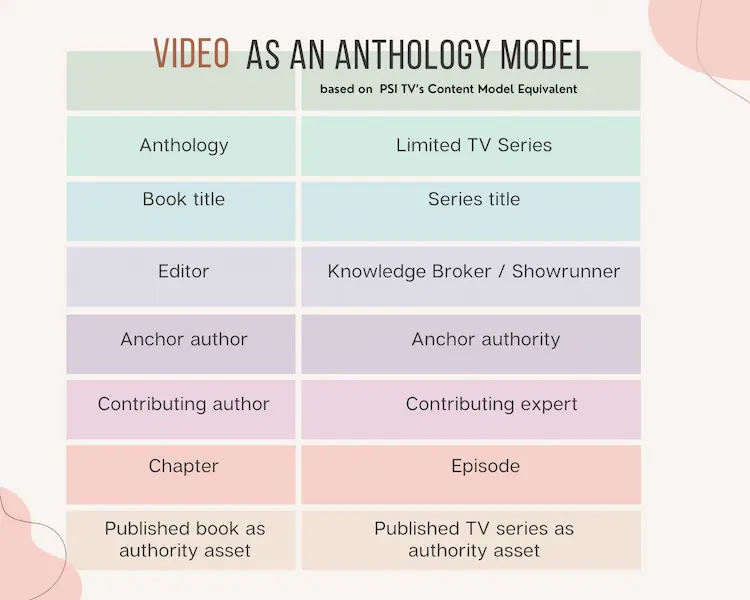
Now the video creation is no longer simply trying to create another video. Instead, it is contributing to, or building, an intellectual media property. That is a very different way to think about content.

Creating Professional Content Does Not Mean Becoming a Video Producer
There is also a practical issue that gets overlooked.
Those seeking online visibility are frequently told they need more videos, so they buy cameras, microphones, and lights. Then they have to learn how to use everything. They have to figure out what to say. They have to become comfortable talking alone to a camera. Then comes editing, graphics, packaging, uploading, and distribution.
Another option is renting a video or podcast studio. That solves the room and equipment problem, but the expert may still need to develop the content, arrange post-production, package the finished media, and distribute it. A production crew can handle much more, but now the expert is commissioning first-party branded content.
There is another model.
Show up and shine.
Bring the expertise you already have to a professional media environment that can provide the interviewer, capture the conversation, edit it, package it, publish it, and distribute it. When that happens within an independent media property, the resulting content carries something self-produced content cannot create by itself: third-party media context.
Being on Television and Owning Television Real Estate Are Different
There is another level beyond appearing in television programming. You can own a branded television destination.
Imagine digital platforms as valuable apartment buildings.
You can build a phenomenal YouTube channel. You can have a beautiful presence on Instagram. You can build an enormous audience inside those properties.
There is nothing wrong with renting excellent real estate. PSI TV itself distributes content through platforms we do not own.
But when your body of work becomes substantial enough, another possibility emerges.
You can own the address.
A branded streaming channel can place your media property inside the same connected-TV ecosystem consumers use to access major entertainment and streaming brands.
That does not mean an independent channel suddenly has Disney's audience, Netflix's capitalization or Hulu's programming budget. It means something much simpler.
You have an address in the neighborhood.
I Remember When Getting Through the Television Gate Was Hard
This transformation is personal for me. Years ago, I worked at the Tampa Tribune. The newspaper operation shared a corridor with sister media operation WFLA Channel 8. I was fascinated by television and spent plenty of time around that environment.
I also learned how difficult television access could be. Knowing people did not mean you simply walked through the door and got someone on television.
Producers mattered.
Relationships mattered.
Programming mattered.
Airtime was scarce.
Television belonged to organizations with the infrastructure, distribution and permission to operate it.
Today, I own a television network. I still find that extraordinary.
PSI TV has been operating since 2019, and our programming can now exist in a television environment that independent publishers of an earlier era could hardly have imagined accessing on their own.
More importantly, the technology now allows us to build branded television channels for other qualified businesses and experts.
The old gate did not simply open. Technology changed the architecture around it.
The Big Digital Brands Are Validating the Address
This brings me back to the question I started with.
YouTube already had extraordinary attention.
Instagram already had extraordinary attention.
Substack already had direct relationships between publishers and subscribers.
Yet they are investing in the television environment.
Substack launched its TV application in January 2026, describing the television as a place where subscribers can settle in for longer-form video viewing. The company also said future development would include sections for different shows from a single publication. [Source: Substack]
Meta is developing Instagram for the television.
YouTube is increasingly talking in the language of creator-led shows.
I cannot tell you that all these companies share one reason for pursuing the big screen.
Their commercial strategies are far more complex than that.
But I can observe their behavior.
Companies that already command enormous digital attention still consider television real estate worth pursuing.
That is a signal I believe independent brands should consider.
You Don't Necessarily Need a TV Channel
This is important.
I build television channels, and I still do not believe everyone needs one. Technology may have democratized access to television, but that does not mean every collection of videos warrants its own television destination.
There is a progression.
You might begin by appearing as a guest.
Then create connected episodes.
Those episodes may develop into a recognizable series.
A series may become a signature show.
And eventually, a substantial body of programming may warrant its own television channel.
The technology is no longer the most interesting limitation.
The question is whether the authority, intellectual property and content are ready to support the address.
So, Is Your Content TV-Ready?
That may be a better question than asking whether television is relevant in 2026.
The world's largest digital platforms are answering the relevance question with their investments.
The audience is answering it with its viewing behavior.
The technology has answered the access question by making television distribution available to organizations that once could never have owned the infrastructure.
Now the question belongs to the brand. Do you have a body of expertise that deserves more than another isolated post?
Can your ideas sustain episodes?
Could those episodes become a show?
Does that show eventually deserve its own address?
TV never died.
It evolved.
And for the first time in television history, independent experts and brands have meaningful opportunities not merely to appear on the screen, but to build media property there.
Ready to Explore Television?
PSI TV creates professionally produced television interview experiences for experts, founders, authors and other subject-matter authorities. You bring the expertise. Show up and shine. We handle the media production, packaging and distribution.
For brands with an established body of video content, PSI TV also builds branded streaming television channels, including Roku channel builds.
Current PSI TV guest appearance: $300.
Starter Roku channel build: $3,000 for one year.
The question is not simply whether you want to be on television.
Is your content TV-ready?
Sources & Further Reading
- Nielsen, April 2026 television viewing data: Nielsen
- YouTube, Brandcast 2026: YouTube Official Blog
- Meta, Instagram for TV expansion, June 2026: Meta
- Substack, TV app announcement, January 2026: Substack
About the Author

Dr. Trudy Beerman
CEO & TV Host, PSI TV Network · Creator of REACHology® & Authority Architecture™
DSL, Liberty University · 2024 Top Leadership Mentor in Media & Brand Influence
Dr. Beerman, the REACHologist®, architects the transition from private brilliance to public authority for established experts. She operates a media visibility and brand-elevation platform for mature/seasoned experts and CEOs ready to expand their influential reach. Through PSI TV, she delivers branded TV exposure, strategic content placement, and multi-channel distribution across Apple TV, Roku TV, and Amazon Fire TV.
Explore the REACHology® Framework
Browse the REACHology® Glossary → · 95+ terms defined by Dr. Trudy Beerman