
TV Becomes LLM Searchable: What LLMs Could Mean for Connected TV and Expert Visibility
By Dr. Trudy Beerman
CEO & TV Host, PSI TV Network | Creator of REACHology®
Published August 12, 2026
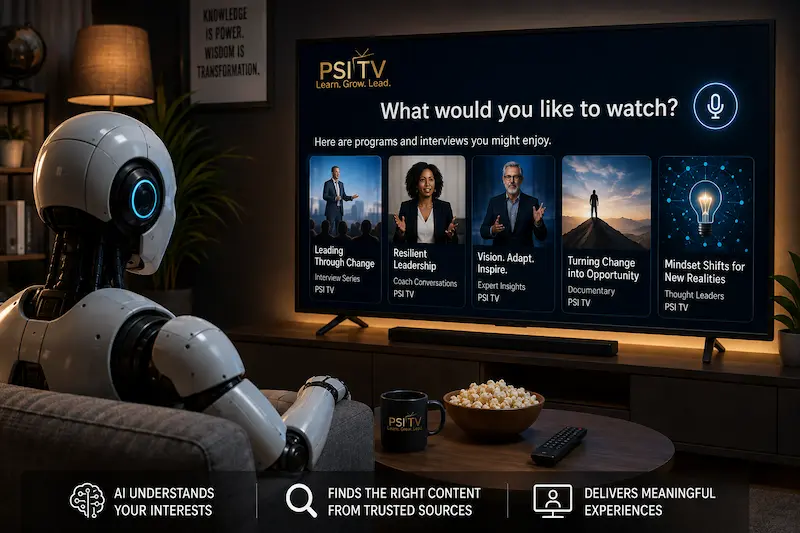
For years, we have treated television and the internet as two different worlds. You searched the internet. You watched television.
That distinction is becoming increasingly difficult to defend.
Connected TV has already transformed the television set from a receiver of scheduled programming into an internet-connected content platform. Now artificial intelligence and large language models are beginning to change how viewers find what they want to watch.
That matters to Netflix. It matters to Amazon. It matters to PSI TV and the channels we build for brands. Because the future of TV may not simply be something you watch. It may be something you search, question and ask for.
Connected TV Is Already TV
It is worth starting with the numbers because connected television is no longer a niche alternative to "real TV."
Gracenote's TV Search and Discovery in the AI Era reports that connected TV accounted for 54% of U.S. television usage in late 2025. Among viewers ages 18 to 34, CTV accounted for an extraordinary 80% of television usage.
Connected TV refers to televisions connected to the internet, most commonly for streaming video. That includes the environments many consumers now access through smart televisions and streaming devices.
In other words, the television screen has become another internet-connected interface.
That changes what television can do.
We Are Moving From Browsing TV to Searching TV
Anyone who has searched for something on a streaming device has already experienced an early version of this.
Begin typing a title and the search results change. Add another letter and they change again. The system attempts to determine what you want before you have finished asking for it.
Traditional television could never do this.
Connected television can.
And now large language models introduce an entirely different level of discovery.
Instead of:
Search: leadership
Imagine:
"Find me a program about becoming a better leader when my company is growing faster than I am."
Or:
"Show me something about how coaches can become more recognizable in their industries."
Or:
"Find an interview about why expertise alone doesn't make someone influential."
Those are not simply keyword searches. They require a system to understand context, meaning and intent.
That is precisely where LLMs become interesting.
This Is Not Merely a Prediction
According to Gracenote, entertainment companies and video publishers have already begun incorporating LLMs into television discovery. The report specifically identifies a proprietary LLM used for content searches on Amazon Fire TV and the integration of Google Gemini for television-related questions on Android TV.
Gracenote argues that LLMs can significantly expand television search because viewers can ask sophisticated questions that go well beyond the limitations of traditional search. These systems could even dynamically augment program descriptions to make them more relevant to an individual viewer.
This deserves attention.
We have spent years talking about AI changing search on computers and mobile devices.
Meanwhile, AI is entering the television experience too.
Why Does Television Need AI Discovery?
Because television now has the same problem the internet has.
Too much content.
Gracenote reported that, as of February 2026, its records contained more than 1.8 million program titles across nearly 350 subscription streaming catalogs, plus almost 210,000 program titles across nearly 2,100 FAST channels.
The abundance sounds wonderful until you are the viewer trying to find something.
Fifty-one percent of Americans say finding what they want is becoming too difficult because there are too many services available.
Viewers spend an average of approximately 14 minutes searching for something to watch. Among viewers ages 18 to 34, that rises to 16 minutes. And 54% of that younger group say they would consider canceling a service because they cannot find something they want to watch.
The problem is no longer simply content creation.
It is content discovery.
Sound familiar?
The Same Problem Experts Have Online Is Coming to Television
This is where the implications become especially interesting for expert-led content.
For years, entrepreneurs have been told to create more.
More videos.
More podcasts.
More articles.
More social posts.
More interviews.
But creating intellectual assets and making those assets discoverable are two entirely different things.
The most brilliant interview in the world has limited strategic value if the people who need its ideas cannot find it.
That has always been true online.
Increasingly, it will be true on television.
This is why metadata, titles, descriptions, topics, categories, expert identity and contextual relationships between content assets may become increasingly important.
Gracenote identifies three significant advantages LLMs can bring to television discovery: improved semantic search, harmonized content catalogs, and powerful ranking and sorting capabilities.
That changes the strategic question.
It is no longer simply:
"Can I get my content on TV?"
The better question may eventually become:
"Can the television ecosystem understand what my content is about well enough to recommend it?"
The Television Appearance Becomes Data
This is where the conversation intersects with something we have been discussing at PSI TV for some time: authority signals.
An expert interview is obviously a piece of video content.
But digitally, it is also information.
There is a guest.
There is a title.
There is a subject.
There is a description.
There are problems discussed.
There are credentials associated with the person speaking.
There may be other episodes addressing related subjects.
There may be a series into which that episode belongs.
Those elements help machines understand the asset.
And machines increasingly mediate discovery.
This does not mean an LLM automatically understands everything about an expert because that person appeared on television. Nor does distribution on a Connected TV platform guarantee that every individual program will be indexed or surfaced by that platform's broader search system.
Those distinctions matter.
But the direction is significant.
Television content is becoming machine-discoverable inventory.
AI Has Another Problem: Trust
There is an interesting tension in the Gracenote research.
Consumers like what AI gives them, particularly direct and comprehensive answers, but they do not necessarily trust those answers.
Gracenote reports that 75% of AI chatbot users verify the results they receive because they worry those results may be incorrect.
This is why the report repeatedly emphasizes grounding.
LLMs predictively synthesize information rather than simply retrieving records from a traditional database. To improve accuracy, they need access to reliable real-world knowledge sources.
For entertainment specifically, Gracenote argues that industry-specific, validated and current data will be necessary for LLM-powered discovery to work effectively.
This principle reaches beyond entertainment.
In an AI-mediated world, publishing something is not necessarily enough.
Machines need signals that allow them to understand what it is, who it involves, what it is about and how it relates to other information.
That is one reason I believe authority building increasingly requires architecture rather than random visibility.
Your Old Content May Become More Valuable, Not Less
There is another implication here that content creators should not overlook.
Traditional social media trained us to think chronologically.
Publish.
Get attention.
Watch engagement decline.
Publish again.
Television libraries do not necessarily behave that way.
Gracenote describes library content as a significant driver of long-tail viewing. In 2025, the ten most-watched licensed television programs distributed by streaming services after airing on traditional television generated 81% more viewing minutes than the ten leading original streaming programs.
The comparison is not intended to suggest that an expert interview will behave like a major entertainment franchise.
The principle is what matters.
Discovery can give older content new life.
Gracenote notes that publishers have more programming than they can possibly feature within the limited visible space of their interfaces. AI-powered discovery offers the possibility of reaching deeper into those libraries rather than relying exclusively on whatever happens to be featured on the screen.
For intellectual content creators, that strengthens the argument for building libraries rather than feeds.
A coherent body of work around a subject becomes increasingly valuable when machines can understand relationships between those assets.
One episode explains an idea.
Another expands it.
Another demonstrates it.
Another provides evidence.
Another applies it to a different situation.
Now you are not merely creating content.
You are creating an intellectual catalog.
Imagine Asking Your Television for a Topic of Interest
This is where I believe things get especially interesting.
Gracenote found that 52% of U.S. consumers believe AI chatbots could become their favorite source for entertainment information. Younger audiences are already using AI to find programming, locate sports and receive content recommendations.
Television is still predominantly perceived as an entertainment medium. Most viewers probably aren't going to sit down and consciously ask their television to "find me an expert."
But they may ask for a topic.
Imagine someone asking:
"Show me something about building a personal brand."
"Find something about starting a business after 50."
"I want to watch something about becoming a better leader."
"Show me interviews about overcoming business failure."
"Find something about writing and publishing my first book."
The viewer doesn't have to know the name of the expert.
They don't have to know the name of the show.
They don't even have to know that a particular piece of content exists.
They simply know what interests them.
If AI-powered television discovery becomes capable of understanding that intent and matching it against the topics, descriptions, metadata and context associated with available programming, the discovery process changes significantly.
Traditional television discovery largely asks:
"What do you want to watch?"
AI-powered discovery can increasingly interpret:
"What are you interested in right now?"
For experts, educators, coaches, authors, speakers and other intellectual content creators, that creates an intriguing possibility.
You may be discovered not because someone searched for your name, but because they searched for what you know.
Being "On TV" May Eventually Be the Least Interesting Part
For PSI TV, this reinforces something important about where television is heading.
Distribution matters.
Being available on Connected TV matters.
But distribution alone is not the finish line.
If television becomes increasingly searchable, conversational and AI-mediated, then discoverability inside the television ecosystem becomes part of distribution itself.
The title matters.
The description matters.
The subject matters.
The expert's identity matters.
The relationship between one piece of content and another matters.
The underlying metadata matters.
And the architecture of the entire content library may matter.
This is one reason PSI TV's strategy is increasingly focused not simply on putting experts on television, but on distributing and reinforcing authority signals across a broader ecosystem.
The Computer, Phone and Television Are Converging
Perhaps the most important conclusion is also the simplest.
The television set is no longer technologically isolated from the digital world.
It is connected.
It has apps.
It has algorithms.
It has search.
It has personalization.
And now it is beginning to have conversational AI.
The interface may be ten feet away instead of ten inches away, but increasingly, the television is another AI-accessed digital environment.
Gracenote concludes that LLMs are likely to become instrumental in helping audiences navigate overwhelming content libraries and maximizing the value of publishers' full video catalogs.
For businesses built around expertise, I would extend that thought one step further.
The opportunity is not merely for the right story to find the right audience.
It is for the right expert content to become discoverable at the moment someone is interested in the subject.
And increasingly, that discovery may happen on the biggest screen in the house.
Is your content TV-ready? Are you our next channel build? If you can YouTube, you can TV! Book a chat to explore this for your brand here.
Reference: Gracenote. TV Search and Discovery in the AI Era. The report incorporates findings from the Gracenote 2026 Generative AI Usage Study, which surveyed more than 4,000 U.S. internet and AI chatbot users ages 13-79 between January 23 and February 4, 2026, along with data from the Gracenote 2025 Streaming Consumer Survey and other Nielsen/Gracenote data sources.
About the Author

Dr. Trudy Beerman
CEO & TV Host, PSI TV Network · Creator of REACHology® & Authority Architecture™
DSL, Liberty University · 2024 Top Leadership Mentor in Media & Brand Influence
Dr. Beerman, the REACHologist®, architects the transition from private brilliance to public authority for established experts. She operates a media visibility and brand-elevation platform for mature/seasoned experts and CEOs ready to expand their influential reach. Through PSI TV, she delivers branded TV exposure, strategic content placement, and multi-channel distribution across Apple TV, Roku TV, and Amazon Fire TV.
Explore the REACHology® Framework
Browse the REACHology® Glossary → · 95+ terms defined by Dr. Trudy Beerman