Digital Discovery: You Want to Be on TV, But Are You Actually Ready
By Dr. Trudy Beerman
CEO & TV Host, PSI TV Network | Creator of REACHology®
Published March 29, 2026
Many experts say they want to be on TV. Far fewer are actually prepared for what television exposure requires. Desire for visibility is common. Readiness for visibility is rare.
Over hundreds of interviews, I have seen the same pattern again and again. People want the authority, the attention, and the implied credibility of being featured, but they have not prepared the pieces that make that visibility useful, sustainable, or even watchable. TV does not create authority. It reveals what is already there, and it exposes what is missingt.
Wishful Thinking Versus Real Readiness
There is a major difference between wanting to be seen and being prepared to benefit from being seen. Some people want the badge, the screenshot, or the thrill of saying they were on TV, but they have not thought through what happens after the interview airs.
That gap matters. If viewers like what they hear, where are they supposed to go next? If your appearance creates curiosity, trust, or interest, do you have a place to send people that continues the conversation and moves them toward a clear next step?
In earlier years, I used to allow guests to tell viewers to send them an email or find them on Facebook. I do not do that anymore. If you are serious about visibility, you need more than a hope and a social profile. You need a digital home.
If You Have No Website or Landing Page, You Are Not TV Ready
One of the clearest readiness signals is whether you have somewhere to send people after they discover you. A TV appearance should not end with vague instructions like “message me on Facebook” or “send me an email.” That creates friction, weakens trust, and wastes attention you worked to earn.
Your visibility should feed your own ecosystem. That could be a website, a landing page, a lead magnet, a booking page, or a clear offer page, but it should be something you control. Rented platforms can support your visibility, but they should not be the only destination you have.
This is part of digital discoverability. If the audience cannot easily find, evaluate, and follow up with you, then the appearance may give you a moment of exposure without producing a lasting business result.
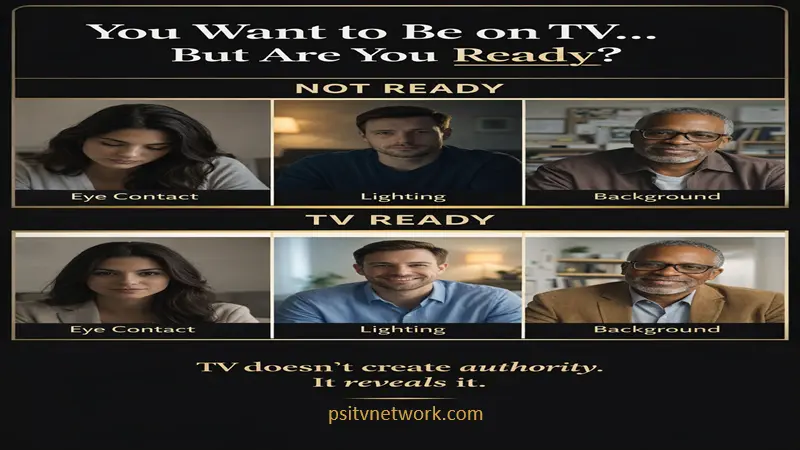
Shy Is Fine. Looking Down at the Floor Is Not
Not everyone is naturally confident on camera, and that is okay. You do not have to be loud, theatrical, or naturally charismatic to do well in an interview. You do, however, need a basic level of comfort looking into a camera, answering clearly, and staying mentally present in the conversation.
When a guest keeps looking down, glancing away, or withdrawing from the camera, the audience feels it immediately. The issue is not perfection. The issue is whether your presence supports or weakens the credibility you are trying to build.
Confidence on camera is a skill, not a personality trait. That is good news, because skills can be improved. But readiness means respecting the medium enough to prepare for it.
Your Background, Lighting, and Internet Are Already Speaking for You
Before you even answer the first question, your environment is already communicating something. Poor lighting, unstable internet, distracting clutter, awkward camera angles, and messy backgrounds do not just look unprofessional. They create doubt.
Television and video interviews are visual credibility experiences. Your setting does not have to be fancy, but it should be intentional. Your environment should support your message, not compete with it.
This is where authority signals matter. The audience is making judgments quickly. Search engines, algorithms, and people all respond to patterns, consistency, and clarity. Your setup is part of the signal.
Evergreen Content Compounds. Dated Content Expires
I strongly prefer evergreen conversations when possible. Timeless content continues to work long after the interview is published. Dated content often forces the platform owner to remember to remove it, update it, or explain why it no longer applies.
That does not mean current events can never be used. It means you should know whether you are creating shelf-stable authority content or temporary commentary. If the topic becomes irrelevant quickly, the interview has a shorter lifespan and less long-term value in the authority-building process.
Evergreen interviews are easier to repurpose, easier to recommend, and easier to keep in rotation. That makes them stronger long-term assets for both the guest and the platform.
If Your Message Is for Everyone, It Is Useful to No One
One of the fastest ways to weaken an interview is to arrive without a qualified audience in mind. Too many experts still believe their message is perfect for everyone. It is not, and it should not be.
Specificity is not a limitation. It is a strength. The clearer you are about who you serve, what problem you solve, and why your perspective matters to that audience, the stronger your interview becomes.
I do not enjoy doing the qualification work for guests who should have done it for themselves before the conversation. A good interview is not built on generic ambition. It is built on a clear point of view, a defined audience, and a message that lands where it is supposed to land.
A Clear Offer Is Part of Readiness
Exposure without a next step is under-monetized visibility. If someone watches you and likes what you have to say, what are they supposed to do next? Buy a book, book a consultation, download a guide, join a list, apply to work with you, visit a landing page, or something else?
You do not have to sound salesy to be clear. But you do need to know the path forward you want the audience to take. A strong interview does not just inform. It positions, directs, and continues the relationship.
This is where many experts lose opportunities, influence, and income. They chase visibility but neglect conversion.
TV Readiness Also Includes Financial Readiness
This is the part people do not always want to hear. Many say they want to be on TV, but they are not prepared to invest in visibility, media preparation, or the assets that make the exposure meaningful. That is wishful thinking, not strategy.
Visibility is not always free, and even when the appearance itself is free, readiness still has a cost. Good lighting costs money. Strong internet costs money. A website costs money. Repurposing, design, systems, and distribution all cost something.
If you want the authority benefits of television but are unwilling to invest in the basics that support it, then you are not really pursuing visibility. You are admiring it from a distance.
Your Book May Already Be Giving You TV Topics
Many authors do not realize how much usable interview content they are already sitting on. If you wrote a book, each chapter may contain its own interview angle, short-form talking point, article idea, or video segment. You may already have far more content than you think.
This matters because readiness is not just about being polished. It is also about being prepared with real substance. A guest who has thought through multiple angles is easier to feature, easier to repurpose, and easier to trust with longer-term visibility.
Getting Accepted Is Its Own Skill
Some experts assume their credentials should automatically open doors. That is not how media works. Being qualified and being bookable are not the same thing.
To get accepted, you need a strong angle, clear positioning, and a reason the audience should care now. This is where media readiness and expert visibility strategy overlap. Your expertise may be real, but your framing still matters.
What TV Producers and Hosts Really Need From You
If you want to be an easy yes, think beyond your own excitement. A good guest makes the host’s job easier, not harder. That means clear answers, a stable setup, a useful topic, a defined audience, and enough composure to deliver value without confusion.
Readiness is respect for the platform, the audience, and the opportunity. The more prepared you are, the more likely your appearance becomes a real authority asset instead of a forgettable moment.
Are You Ready to Be Featured on TV?
Ask yourself a few honest questions. Do you have a website or landing page? Can you look into a camera with basic comfort? Is your lighting and background credible? Is your topic evergreen or intentionally timely? Do you know who you serve? Do you have a clear offer? Are you prepared to invest in visibility as strategy, not fantasy?
If the answer to several of those is no, that is not the end of the story. It just means your next move is not “get on TV at any cost.” Your next move is to close the readiness gap.
TV Does Not Create Authority. It Reveals It.
Television can amplify what is already there. It can accelerate trust, sharpen perception, and expand reach. But it does not fix a weak offer, replace a missing website, hide unpreparedness, or clarify a message you have not bothered to define.
That is why readiness deserves more attention than wishful thinking. The goal is not simply to appear. The goal is to be seen in a way that builds lasting authority.
If you are serious about becoming more visible, discoverable, and credible, start by understanding the gaps that are holding you back. That is where authority signals, digital discoverability, and a stronger PSI TV strategy begin to matter.
Frequently Asked Questions About TV Readiness for Experts
Do you need to be famous to get on TV as an expert?
No. Fame is not the requirement. Clear positioning, a useful message, a credible setup, and the ability to serve the audience well matter far more than celebrity.
Can a shy person still do well on TV?
Yes. You do not need to be naturally outgoing to be a strong guest. You do need a basic level of camera comfort, focus, and willingness to communicate clearly.
Why is a website important before going on TV?
A website or landing page gives people somewhere to go after they discover you. Without that next step, the attention created by your appearance can easily be wasted.
What kind of content works best for TV interviews?
Evergreen content usually performs best over time because it remains relevant and easier to repurpose. Timely content can work too, but it has a shorter shelf life.
What if I have expertise but no clear offer yet?
Then your priority is to clarify the next step before chasing visibility. Exposure is most valuable when it connects to an offer, a message, and a destination that make sense.
About the Author

Dr. Trudy Beerman
CEO & TV Host, PSI TV Network · Creator of REACHology® & Authority Architecture™
DSL, Liberty University · 2024 Top Leadership Mentor in Media & Brand Influence
Dr. Beerman, the REACHologist®, architects the transition from private brilliance to public authority for established experts. She operates a media visibility and brand-elevation platform for mature/seasoned experts and CEOs ready to expand their influential reach. Through PSI TV, she delivers branded TV exposure, strategic content placement, and multi-channel distribution across Apple TV, Roku TV, and Amazon Fire TV.
Explore the REACHology® Framework
Browse the REACHology® Glossary → · 95+ terms defined by Dr. Trudy Beerman