
Build It to Earn. Build It to Sell.
By Dr. Trudy Beerman
CEO & TV Host, PSI TV Network | Creator of REACHology®
Published September 15, 2026
Why I’m building PSI TV as an income-producing media asset today and a potentially acquirable company tomorrow.
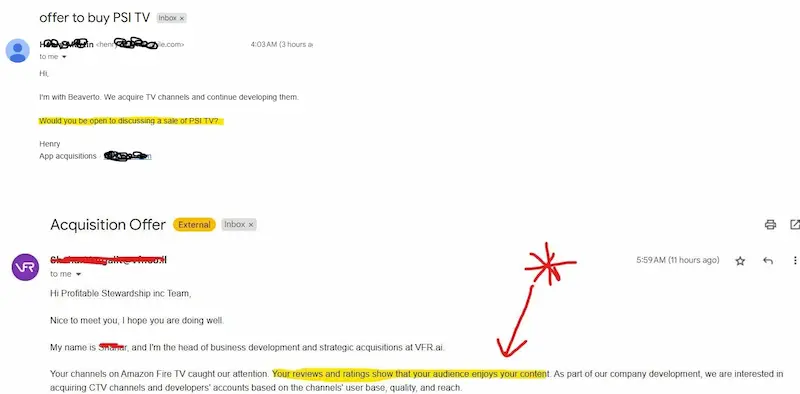
Every now and then, an interesting email lands in my inbox.
Would you be open to discussing a sale of PSI TV?
I have received variations of that inquiry more than once. Companies that acquire television channels have contacted me about PSI TV, and even one of the television channels I built for someone else subsequently attracted a buyout inquiry.
I haven't sold.
In fact, my long-range plan is to continue building PSI TV with approximately 2036 in mind as a possible exit horizon. My goal is ambitious: to build an enterprise capable of commanding a high-seven-figure to eight-figure exit valuation.
That is a goal, not a claim about what PSI TV is worth today and certainly not a guarantee of what someone will pay tomorrow.
But those acquisition inquiries have caused me to think differently about something entrepreneurs deal with constantly: expense.
Sometimes what looks like an expense today is actually part of the cost of constructing an asset.
The Long Game Changes the Math
Building a media company costs money.
There are technology costs, distribution costs, production costs, marketing costs, platform costs and development costs. Some investments can be directly connected to revenue. Others cannot.
If I judge every PSI TV expense by asking, “Did this particular expenditure make its money back this month?” some investments could look like bad decisions.
But that isn't the only question I am asking. I am also asking, “Did this make PSI TV more valuable?”
Those are very different questions. The first measures an immediate return. The second considers what I am constructing.
That distinction becomes particularly important when the business itself may eventually be sold.
But I Don't Have to Wait Until 2036 to Make Money
An exit strategy does not mean spending money for ten years while hoping somebody eventually writes a large check.
A well-built media asset can earn while you own it.
There are many ways to monetize a television channel, and the right model depends upon what the owner is trying to accomplish.
Advertising is an obvious option. I have personally chosen not to run traditional advertising on PSI TV, but another channel owner absolutely could.
Paid programming is another. Some people pay to appear on PSI TV because they want the visibility, positioning, distribution and media assets that come with an appearance.
But even a guest who pays nothing can potentially contribute to the economic value of a show.
A business owner could intentionally invite people who fit the company's ideal client profile to be guests. Instead of opening the relationship with a sales pitch, the relationship begins with a conversation. The business gives first through attention, exposure and an opportunity for the guest to tell their story.
That goodwill can change the sales relationship. The show becomes part media property and part business-development infrastructure.
A brand can also sell directly from its programming, use television to demonstrate its expertise or products, build sponsorship opportunities, create premium content, develop subscriptions, or sell programming and distribution space to other brands.
Companies have already built variations of these models. e360tv, for example, distributes creator programming across Roku, Amazon Fire TV, Apple TV and Android TV, in addition to web and mobile distribution. [Source: e360tv]
The point isn't that every channel should use every revenue model. It is that the channel itself creates options.
Some of those options generate direct revenue. Others generate relationships, authority, leads, goodwill, content assets and opportunities that eventually produce revenue somewhere else in the business.
Television Isn't Disappearing. Television Is Changing.
This is the part I believe many business owners are missing.
People sometimes talk about television as though it is an old medium being replaced by social media and online video. The numbers tell a more interesting story.
In May 2026, streaming represented 48.6% of all television usage, according to Nielsen. YouTube alone accounted for 13.8% of television watch-time, making it the largest media distributor measured by Nielsen that month. [Source: Nielsen]
YouTube itself reported that television had surpassed mobile as the primary device for YouTube viewing in the United States by watch time, with viewers watching more than one billion hours of YouTube on televisions every day. [Source: YouTube]
Think about what that means.
YouTube owns one of the most powerful video platforms ever created, and YouTube still wants to be on your television.
It doesn't treat the television screen as competition with its platform. The television screen is another place its platform needs to be.
That should tell us something.
Roku's Numbers Make the Opportunity Difficult to Dismiss
Roku provides another useful window into where viewing behavior is going.
According to Roku's 2025 annual report, viewers streamed 145.6 billion hours through the Roku platform during 2025, compared with 127.1 billion hours in 2024, a 15% increase. Roku describes itself as the leading TV streaming platform by hours streamed in the United States, Canada and Mexico. [Source: Roku 2025 Annual Report, SEC]
This isn't simply television moving from cable to another cable-like service. It represents a fundamental change in distribution.
The television screen is increasingly becoming an interface through which viewers choose among streaming services, creator content, traditional entertainment, live programming, podcasts and other forms of video.
That creates room for brands and independent media owners that would never have owned television distribution in the traditional broadcast era.
Now Instagram Wants Your Television Too
Perhaps one of the clearest signals is what the social platforms themselves are doing.
Instagram spent years training us to consume content on a phone.
Then it went to television.
Instagram for TV launched on Amazon Fire TV in late 2025 and subsequently expanded to Google TV. By June 2026, Meta announced expansion to Samsung TVs and said that, combined with Fire TV and Google TV, Instagram was available across the majority of connected-TV devices in the United States. [Source: Meta]
And Meta isn't merely mirroring Instagram onto a larger screen. It is experimenting with channels, horizontal video, longer-form creator programming, episodic series and live television experiences. [Source: Meta]
That distinction matters to me.
Instagram isn't merely putting social media on a television. It is experimenting with making social content behave more like television.
And Then There Is Substack
Substack is another fascinating example because its roots aren't even primarily in video.
It built its reputation around newsletters and subscription publishing. Then it expanded into video.
In January 2026, Substack launched a television app for Apple TV and Google TV, allowing subscribers to watch creators' videos and livestreams on the television screen. [Source: Substack]
Think about that progression. A newsletter platform expanded into video, and then video expanded into television.
YouTube is there. Instagram is moving there. Substack is there.
These are companies with enormous amounts of behavioral data telling them where and how people consume content.
The big boys apparently see something valuable on the biggest screen in the house.
As a smaller media company, I pay attention to signals like that.
TV Doesn't Have to Replace Your Other Platforms
This is also why I don't view television as an alternative to YouTube, podcasts, social media or a website. I see it as another layer of distribution.
The same intellectual property can move through different environments, but the environment changes how that content is perceived and consumed.
Someone watching an interview on a phone while scrolling through a feed is having a different experience from someone selecting programming on a television. The content may be identical, but the context is not.
And for a personal brand, context matters.
This is part of why I believe media portfolios will become increasingly important. Instead of asking, “Which platform should I be on?” sophisticated brands can ask, “Where should my authority be distributed?”
Television can be one answer.
Build an Asset, Not Another Job
There is an important warning here for founders, including me.
If PSI TV only works because Trudy Beerman works, I haven't necessarily built a valuable transferable enterprise. I may have built myself a very sophisticated job.
For my 2036 strategy to work, PSI TV has to become increasingly capable of operating without my constant personal involvement.
The systems matter. The distribution matters. The audience matters. The intellectual property matters. The technology matters. The processes matter. Recurring revenue matters. The relationships matter. And the ability to transfer those things to another owner matters.
That also changes the way I evaluate automation and infrastructure. An investment that removes me as a bottleneck may not immediately increase this month's sales, but it could make the enterprise more scalable and ultimately more transferable.
A Buyer Isn't Buying My Memories
I can decide that I want an eight-figure exit. I cannot decide that somebody will give me one.
A future buyer isn't obligated to compensate me for how hard I worked, how many late nights I spent building PSI TV or how emotionally attached I am to what I created.
A buyer will have to see economic or strategic value in owning what I built. That is why the next decade matters.
I need to build something another company has a reason to want.
Revenue helps. Profitability helps. Audience helps. Distribution helps. Systems help. Intellectual property helps. Brand equity helps. Recurring revenue helps. And evidence that the company can continue functioning after its founder leaves helps.
The objective isn't merely to make PSI TV bigger.
The objective is to make PSI TV increasingly valuable without making it increasingly dependent upon me.
Those Emails Are Signals, Not Valuations
I am careful about how I interpret the acquisition inquiries I have received.
Someone asking whether I would consider selling PSI TV has not established what PSI TV is worth.
It does, however, establish something else that I find useful.
Someone looked at an asset I built and thought: I might want to own that.
That is fundamentally different from someone thinking, I might want to buy something from that company.
One creates a potential customer. The other suggests that the asset itself may someday become the product.
Even more interesting to me is that a channel I built for someone else also attracted acquisition interest. That tells me to continue paying attention to what I am actually constructing when I build media infrastructure.
Earn During the Holding Period. Build Value for the Exit.
This is ultimately the model I am pursuing.
I don't want to wait until 2036 for PSI TV to have economic value. I want the asset producing economic benefits while I own it.
Some of that can be direct revenue. Some can come from paid appearances, programming, distribution and other media services. Some can come indirectly through relationships, authority, customer acquisition, goodwill and opportunities created because the platform exists.
Meanwhile, every system I improve, every distribution point I establish, every process I document, every revenue stream I make less founder-dependent and every piece of defensible value I create should contribute to the larger enterprise I am building.
So when another expense hits, I still care about ROI. I just don't limit ROI to “How quickly did this money come back?”
I also ask what that expenditure helped me own.
And when another acquisition email arrives, my answer for now remains essentially the same.
Not yet. I'm still building.
My goal is simple enough to say, even if it takes another decade to accomplish:
Build it to earn while I own it. Build it to be worth buying when I'm ready to leave it.
“The plans of the diligent lead surely to abundance.”
Proverbs 21:5, ESV
About the Author

Dr. Trudy Beerman
CEO & TV Host, PSI TV Network · Creator of REACHology® & Authority Architecture™
DSL, Liberty University · 2024 Top Leadership Mentor in Media & Brand Influence
Dr. Beerman, the REACHologist®, architects the transition from private brilliance to public authority for established experts. She operates a media visibility and brand-elevation platform for mature/seasoned experts and CEOs ready to expand their influential reach. Through PSI TV, she delivers branded TV exposure, strategic content placement, and multi-channel distribution across Apple TV, Roku TV, and Amazon Fire TV.
Explore the REACHology® Framework
Browse the REACHology® Glossary → · 95+ terms defined by Dr. Trudy Beerman