
Before You Pay for Media Exposure, Ask What Authority Signals You’re Actually Buying
By Dr. Trudy Beerman
CEO & TV Host, PSI TV Network | Creator of REACHology®
Published September 08, 2026
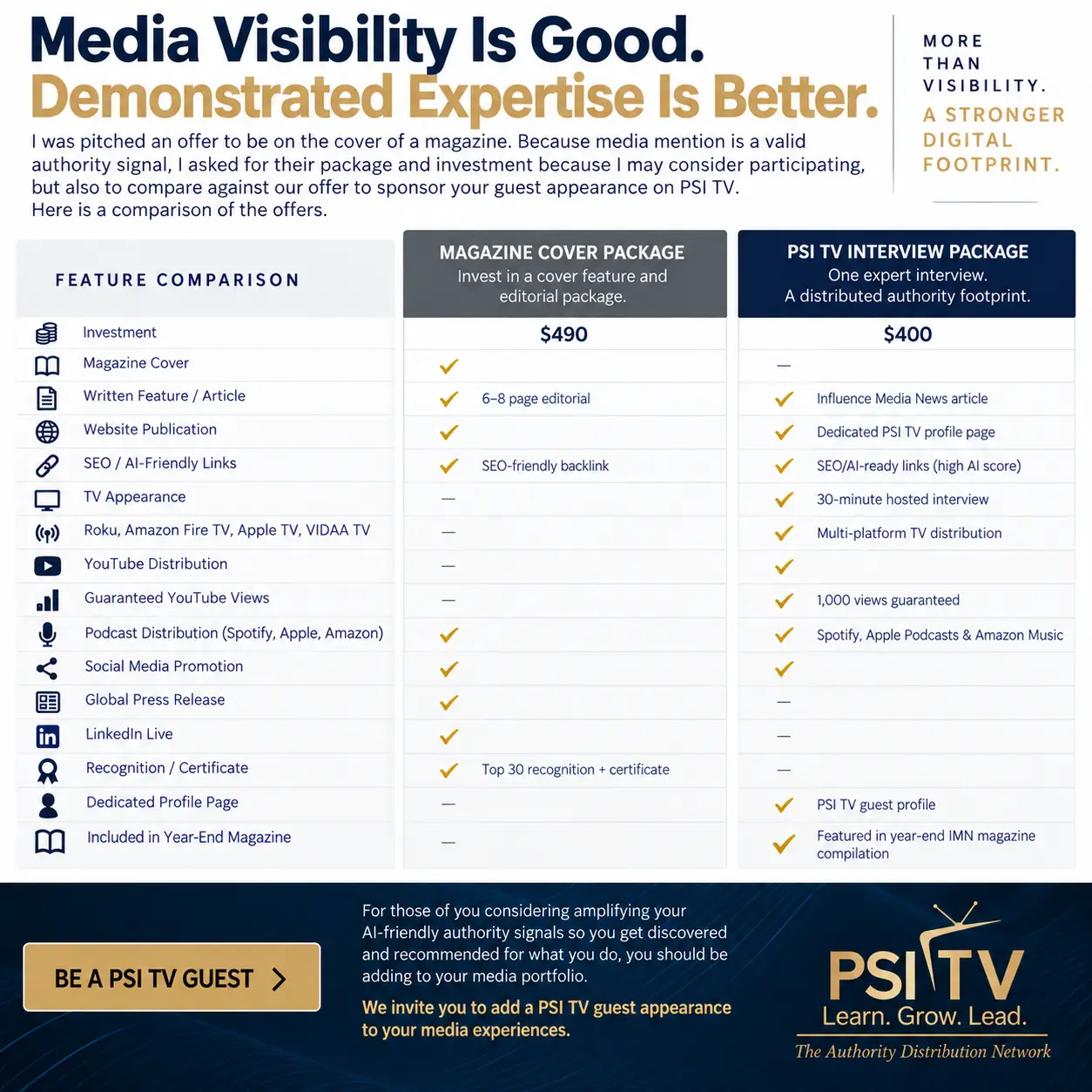
Recently, I received a pitch inviting me to appear on the cover of a business magazine. I asked for the package and the investment.
There were two reasons. First, media mentions are legitimate authority signals, and I practice what I teach. I intentionally build my own media portfolio even though I own a television network. Second, I wanted to compare what this company offered for $490 with what PSI TV provides when an expert sponsors a $400 guest appearance.
The exercise reminded me that when evaluating media, the most important question is not simply, “How impressive will this look?” A better question is: What will exist after I pay for this opportunity, and what will that evidence say about me?
Paid Media Is Not Automatically Bad Media
There is a tendency to divide media into two simplistic categories: earned media is good and paid media is bad. I don't subscribe to that thinking.
PSI TV offers sponsored guest appearances. I would be hypocritical if I suggested that paying for access automatically invalidates the media signal.
A business pays for advertising. An author pays to exhibit at a conference. A company sponsors an event. An expert may pay production fees associated with an interview, television appearance, advertorial, conference presentation, or other media opportunity. The financial arrangement tells us how access occurred. It does not, by itself, tell us whether the resulting asset has value.
What matters is what the investment produces. Does the opportunity place you before an audience you do not already own? Does it create searchable evidence connected to your expertise? Does another organization publish information about you? Do you have useful media you can reference afterward? Can someone investigating you find it? Does it create video, audio, editorial, television, web, or other evidence that strengthens your existing authority footprint?
I Practice What I Teach
I own PSI TV. I have my own websites, publications, YouTube channels, podcasts, and media infrastructure. Technically, I could stay inside my own ecosystem and publish myself indefinitely.
But I intentionally appear on other people's podcasts, shows, publications, stages, and media platforms because third-party media adds something my owned platforms cannot provide in quite the same way: corroboration.
I can publish an article saying that I understand digital authority. I can host a PSI TV episode explaining REACHology® or Authority Architecture™. Those owned assets are important because they establish my ideas, language, expertise, and body of work. But when another host interviews me, another publication features me, or another organization invites me onto its stage, a separate entity has now connected my name with that expertise.
That is a different signal. Proverbs 27:2 says, “Let another man praise thee, and not thine own mouth.” The verse was written long before Google, television, podcasts, backlinks, or AI, but the reputational principle remains remarkably relevant. There is value in what you say about yourself, but there is a different kind of value when another source says it too.
That is why I continue to pursue third-party media even though I own media myself. A strong authority footprint benefits from both owned evidence and third-party evidence.
The $490 Media Offer Was Actually Pretty Good
The magazine proposal included a cover feature, a six-to-eight-page editorial story, permanent website publication with an SEO-friendly backlink, podcast distribution through several major platforms, a press release, social media promotion, a LinkedIn Live appearance, a leadership recognition, and a certificate.
For $490, that is a substantial collection of deliverables. I don't need to diminish their offer to make ours look better. In fact, a magazine cover can become a particularly attractive visual authority asset. A professionally written editorial provides another searchable piece of content. A press release adds another publication event. Podcast distribution creates audio presence.
The proposal was useful because it forced me to examine the same question from the other side: What does someone actually receive for a $400 sponsored guest appearance on PSI TV?
One PSI TV Interview Creates More Than One Media Signal
A PSI TV guest begins with a professionally hosted 30-minute interview. The appearance is distributed through television and streaming environments that include Roku, Apple TV, Amazon Fire TV and VIDAA TV, as well as YouTube and podcast platforms. PSI TV's current guest offering also includes at least 1,000 YouTube views.
But the interview is only the source asset.
The guest also receives a dedicated PSI TV profile page. That page becomes an indexed record connecting the guest's identity, expertise, business, interview and related information. Our digital infrastructure has been intentionally developed with SEO and AI discoverability in mind, so the guest is not simply receiving another webpage. The profile becomes another structured digital dot connecting the person with the expertise they want to be known for.
The interview also becomes the foundation for an editorial article published through Influence Media News. At year-end, guest profiles are included as part of the annual IMN magazine compilation. The guest therefore leaves with television, video, audio, editorial and web evidence generated from one media experience.
That distinction matters to me because my goal is not to create a temporary burst of visibility. It is to create digital dots that remain behind after the appearance is over.
Placement and Audience Are Not the Same Thing
One of the things I look for when evaluating any media proposal is the difference between distribution and consumption.
Being available on Spotify does not tell me how many people listened. Having an article online does not tell me how many people read it. Having a press release distributed does not tell me how many people encountered it. Being published in a digital magazine does not tell me how many people opened the magazine.
Those placements can still be useful authority signals, but availability should not automatically be interpreted as audience. Because a TV appearance also does not offer visible metrics on TV as social posts do, that is one reason PSI TV distributes to platforms where metrics are visible, including a minimum audience commitment with its guest interviews. The current offer includes at least 1,000 YouTube views in addition to multi-platform distribution.
I pay attention to this distinction in my own marketing as well. Views, watch time, search impressions, applications, invitations, conversions, and other observable behavior are data. I would rather examine what actually happened than force an attractive interpretation onto a metric simply because I like how it sounds. Media should be evaluated the same way.
Being Written About and Being Interviewed Prove Different Things
I value editorial media. We publish editorial articles ourselves through Influence Media News. But an article and an interview do not create exactly the same kind of evidence.
A writer can describe someone as knowledgeable. An interview gives that person an opportunity to demonstrate the knowledge. The guest must explain an idea, answer questions, provide context, tell stories, respond in real time, and articulate a point of view.
For consultants, speakers, authors, executives, coaches, founders, and other knowledge-based professionals, that can be particularly useful because a prospective client or opportunity partner gets to experience how the expert thinks. This is one reason I view long-form interviews as authority infrastructure rather than simply content. The recording can continue working long after the conversation ends.
Now There Is Another Audience: Machines
There is also a newer reason to think carefully about the digital evidence we create.
People are increasingly using AI systems as information-discovery tools. Pew Research Center reported in June 2026 that 42% of U.S. adults who use AI chatbots say they use them to search for information. Pew also found that 60% of U.S. adults say they read AI-generated summaries appearing in search results.
That does not mean publishing an article, getting a backlink, or appearing on television guarantees that ChatGPT, Google, or another AI system will recommend you. Anyone promising that from a single tactic is promising more than the evidence supports.
It does mean the environment in which people discover information is changing. This is why my work increasingly considers two audiences for authority signals: people and machines.
When someone searches your name, investigates your expertise, asks an AI system for possible resources, or encounters an AI-generated search summary, the digital information available about you matters. That makes coherent, accurate, searchable evidence increasingly important.
More Content Is Not Necessarily More Authority
There is another complication. We now operate in an environment where creating content has become extraordinarily easy.
In August 2026, Pew Research Center examined nearly half a million English-language webpages from the Common Crawl archive to study how much online material appears to have been written or substantially edited using AI. The research illustrates how dramatically generative AI is changing the volume and nature of web content.
That makes proof more interesting to me than sheer content volume.
Anyone can publish dozens of articles saying that they are an expert. Anyone can create graphics saying they are a thought leader. Anyone can fill a website with claims. It is harder to manufacture a coherent history of actual activity across independent environments: interviews, presentations, publications, books, citations, professional profiles, client evidence, credentials, media appearances, and other observable signals.
This is one of the central ideas behind REACHology® and Authority Architecture™. The objective is not to scatter random mentions of your name around the internet. The objective is to create a body of relevant evidence that consistently connects who you are, what you know, what you have done, and what you are known for.
Not Every Digital Dot Proves the Same Thing
This is also why I don't score every media mention, badge, award, certificate, backlink, podcast, article, or television appearance as though they were interchangeable.
Imagine three authority signals. One organization independently selects an expert for an award. Another expert pays a production fee to participate in a legitimate interview where they must demonstrate their expertise. A third person purchases a package in which an award or recognition is automatically included among the deliverables.
All three may result in searchable evidence. But they don't have identical provenance, and they don't prove identical things.
That does not mean one must be worthless and another valuable. It means an intelligent authority strategy asks, “What exactly does this signal prove?” That question is becoming increasingly important in a world overflowing with content, badges, rankings, awards, features, and self-published claims.
Build a Media Portfolio, Not a Trophy Case
This is why I may still pay for a media opportunity like the one that prompted this article. I don't need every media opportunity to accomplish the same thing.
A magazine cover can provide a visual authority asset. A written profile can create editorial evidence. A television interview demonstrates expertise. A podcast adds long-form audio presence. A press release creates another searchable publication event. A speaking appearance shows that an organization trusted you with access to its audience.
The 2026 Edelman Trust Barometer offers another reason to take third-party trust seriously. Edelman's global research describes an increasingly insular trust environment in which trusted outside voices can play an important role in credibility and consideration.
Your goal, therefore, should not be to collect impressive-looking trophies. Build a media portfolio.
A media portfolio contains different forms of evidence, from different sources, serving different purposes and reaching different audiences. Some of it may be earned. Some may be owned. Some may be sponsored. What matters is whether those assets collectively make your expertise easier to discover, verify, experience, and understand.
What Are You Actually Buying?
That brings me back to the $490 magazine proposal. I wasn't offended that they wanted me to pay. I asked because I wanted to know exactly what the investment purchased.
After comparing the offer with our $400 PSI TV guest experience, I came away appreciating both the competitive intelligence and something I already teach my clients: Do not buy media simply because you want to say you were featured somewhere.
Ask what remains afterward. Ask whether you are receiving an article, profile, interview, video, audio recording, backlink, television appearance, press reference, audience exposure, searchable record, or other reusable evidence. Ask whether the opportunity introduces you to an audience you didn't already own.
Ask whether it strengthens an existing authority story or simply creates another disconnected logo. And ask whether, six months from now, the media experience will still be doing something useful for your reputation.
At PSI TV, that is what we are trying to build from one guest experience. The interview becomes television content, video, podcast content, a dedicated profile, editorial coverage, social material, and part of a larger searchable media footprint.
One appearance. Multiple authority signals.
If you already have expertise worth discovering, your media portfolio should help people and machines find the evidence.
That is the point.
Research Referenced
- Pew Research Center. Americans and AI 2026: Chatbots, Smart Devices and Views on Impact. June 17, 2026.
- Pew Research Center. How Much of the Internet Is Written With AI? August 20, 2026.
- Edelman. 2026 Edelman Trust Barometer.
About the Author

Dr. Trudy Beerman
CEO & TV Host, PSI TV Network · Creator of REACHology® & Authority Architecture™
DSL, Liberty University · 2024 Top Leadership Mentor in Media & Brand Influence
Dr. Beerman, the REACHologist®, architects the transition from private brilliance to public authority for established experts. She operates a media visibility and brand-elevation platform for mature/seasoned experts and CEOs ready to expand their influential reach. Through PSI TV, she delivers branded TV exposure, strategic content placement, and multi-channel distribution across Apple TV, Roku TV, and Amazon Fire TV.
Explore the REACHology® Framework
Browse the REACHology® Glossary → · 95+ terms defined by Dr. Trudy Beerman