
Attention Is Never Free: The Three Costs Founders Pay to Be Seen
By Dr. Trudy Beerman
CEO & TV Host, PSI TV Network | Creator of REACHology®
Published July 28, 2026
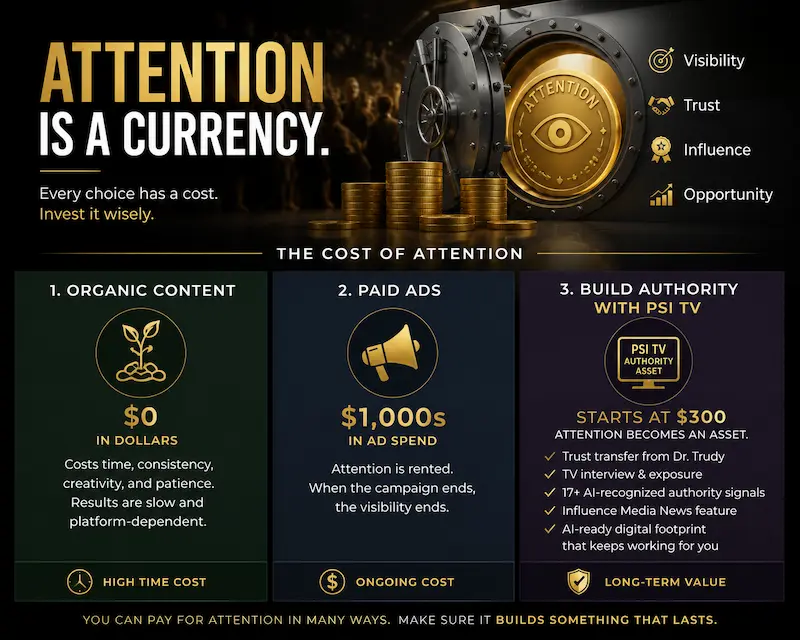
Every business needs attention. Before someone can consider your offer, trust your expertise, recommend your name, or become a customer, they must first know that you exist. The challenge is that attention has become one of the most contested resources in the marketplace.
Founders are competing not only with businesses offering similar services, but also with news, entertainment, influencers, advertisements, personal messages, and an endless supply of digital content. The result is a marketplace in which attention may appear free, but someone always pays for it. The payment may be made with time, advertising dollars, or an investment in credible media assets that continue working after publication.
Most marketing services and business education focus on acquiring attention. REACHology® teaches people how to become worthy of recommendation before the attention arrives.
Price One: Organic Attention Is Free, but It Is Slow
Posting organically on social media carries no direct advertising charge. A founder can publish videos, articles, photographs, and opinions without paying the platform for each post. That makes organic content accessible, but it does not make it free. The real cost is paid through time, consistency, creative energy, production, and the opportunity cost of work that could have been completed elsewhere.
Organic visibility is also platform-dependent. A founder may create valuable content, yet the platform still determines how widely that content is distributed. Followers do not automatically see every post, and strong content is not guaranteed to be indexed, ranked, recommended, or placed in front of the people most likely to value it.
Google makes a similar distinction regarding search visibility. Its documentation states that even when a page follows its technical and quality guidance, Google does not guarantee that the page will be crawled, indexed, or served in search results.1 Google also explains that its ranking systems consider a variety of signals when attempting to identify helpful, reliable content that demonstrates experience, expertise, authoritativeness, and trustworthiness.2
Organic content remains important because it allows a founder to communicate ideas, demonstrate consistency, and build a body of work over time. However, it is usually a long game. It requires the founder to keep producing while accepting that distribution may be uneven, unpredictable, and limited by systems the founder does not control.
Price Two: Paid Attention Is Faster, but It Is Rented
Advertising allows a business to bypass some of the waiting associated with organic growth. A founder can pay to place a message before a defined audience, test different offers, generate traffic, and increase awareness more quickly. Used strategically, advertising can be a valuable component of a company’s growth plan.
The limitation is that advertising primarily rents distribution. The platform delivers impressions, clicks, or views while the campaign is active and funded. Once the campaign ends, that purchased stream of attention usually ends with it. The founder may retain the advertisement itself and any leads it generated, but the placement was temporary.
Paid attention also does not automatically produce trust. Nielsen’s research has repeatedly found that people place greater trust in recommendations from people they know than in many forms of paid advertising. In one global study, 88 percent of respondents said they trusted recommendations from people they knew more than any other channel.3
This does not mean advertising is ineffective. It means visibility and credibility are different outcomes. An advertisement can introduce a name, but the prospect may still search for interviews, articles, media mentions, reviews, credentials, and other independent signals before deciding that the person behind the advertisement is trustworthy.
Price Three: Media Attention Builds an Authority Asset
The third option is to invest in attention that produces reusable evidence. Instead of paying only for an impression, the founder creates media assets that can be found, watched, shared, cited, and evaluated long after the original appearance. A professional television interview, published feature, searchable biography, authoritative backlink, video segment, or media profile can become part of the founder’s lasting digital footprint.
This is where a PSI TV guest appearance differs from buying an advertisement. Starting at $300, the founder is not merely paying to have a message displayed temporarily. The founder is entering an established media environment and gaining the trust transfer that occurs when host Dr. Trudy Beerman introduces the guest, explores the value of the guest’s work, and presents that expertise to an existing audience.
The PSI TV experience is also designed to produce more than a single video. Depending on the selected guest package, the appearance can contribute television exposure, an Influence Media News feature, searchable media content, authority backlinks, and more than 17 digital authority signals across the PSI TV distribution ecosystem. These signals give prospective clients, search systems, and AI-powered discovery tools more evidence through which to understand who the founder is, what the founder does, and why that person may be relevant to a particular question.
That distinction matters as search behavior evolves. Google states that its generative AI search features continue to rely on its core search ranking and quality systems, and that established SEO practices remain relevant to visibility within AI Overviews and AI Mode.4 Research into Generative Engine Optimization has also found that well-supported content containing citations, relevant quotations, and statistics can increase source visibility within generative responses, although results vary by subject and platform.5
No ethical media company can guarantee that a particular AI system will recommend a person. What can be built is the body of credible, consistent, machine-readable evidence from which both people and technology can form an informed conclusion. Without that evidence, even a highly capable founder may remain digitally difficult to verify.
The Difference Between Attention and Recognition
Attention means someone noticed you. Recognition means that person can place your name within a meaningful category. Authority means there is enough evidence for the person to believe that your knowledge, experience, or work deserves consideration. These outcomes are connected, but they are not interchangeable.
A viral post may create attention without recognition. An advertisement may create awareness without transferring trust. A strong media appearance can do more because it provides context, third-party association, and a durable record of the founder articulating the value of the work.
This is also why the cost of remaining invisible cannot be calculated as zero. Invisibility may not produce an invoice, but it can cost speaking invitations, partnerships, media opportunities, referrals, and sales. A founder cannot know which opportunities never arrived because the decision-maker could not find enough evidence to confidently choose or recommend that founder.
Choose What You Want Your Investment to Leave Behind
Organic content costs time and offers gradual, platform-limited distribution. Advertising purchases faster visibility, but much of that visibility remains tied to the campaign budget. Credible media exposure requires an investment, but it can leave behind authority assets that continue contributing to the founder’s digital identity.
Most growing businesses will eventually use all three. They will publish organically, advertise strategically, and pursue credible media opportunities. The important question is not whether attention costs money. The more useful question is what remains after the money, time, or energy has been spent.
When the post disappears from the feed and the advertising campaign ends, does the founder have anything new that can still be found, shared, watched, and trusted? That is the difference between temporarily attracting attention and deliberately building influential reach.
Turn Your Expertise Into a Media Asset
A PSI TV guest appearance begins at $300 and is designed to create more than a moment of visibility. It creates a professionally presented media experience supported by television exposure, digital distribution, trust transfer, and authority signals that can continue working after the interview.
Do not merely pay to be seen. Invest in evidence that gives people and AI systems more reasons to recognize, trust, and recommend you.
About the Author

Dr. Trudy Beerman
CEO & TV Host, PSI TV Network · Creator of REACHology® & Authority Architecture™
DSL, Liberty University · 2024 Top Leadership Mentor in Media & Brand Influence
Dr. Beerman, the REACHologist®, architects the transition from private brilliance to public authority for established experts. She operates a media visibility and brand-elevation platform for mature/seasoned experts and CEOs ready to expand their influential reach. Through PSI TV, she delivers branded TV exposure, strategic content placement, and multi-channel distribution across Apple TV, Roku TV, and Amazon Fire TV.
Explore the REACHology® Framework
Browse the REACHology® Glossary → · 95+ terms defined by Dr. Trudy Beerman